

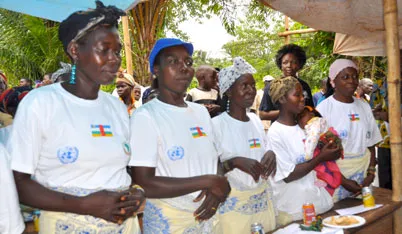
The Gender Unit of BINUCA is mandated to facilitate the integration of gender equality within the mission and across its areas of work, including in policies and programmes such as Disarmament, Demobilization and Reintegration (DDR) and Security Sector Reform (SSR). In practice, this includes training on gender, developing gender-sensitive policy, and disseminating information on Resolution 1325 and the fight against all forms of conflict-related sexual violence. It also includes the implementation of Resolution 1325 through working partnerships within the mission and in collaboration with UN Agencies, the Government, and NGOs operating in the Central African Republic.
Organizational structure
The Gender Unit of BINUCA reports to the Office of the Special Representative of the Secretary-General in the Central African Republic. It maintains an overview of BINUCA’s various activities, ensuring respect for gender and child protection.
Mainstreaming gender in the mission’s programmes
Gender mainstreaming across BINUCA’s programmes and components is a priority of the Department of Political Affairs (DPA).
As part of this integration, gender is considered in the RBB, UNDAF, mission policies, DDR, SSR, and the various sections of the mission, such as the Political Affairs Section, the Public Information Section, the Security Institutions Unit, and the Human Rights and Justice Section, among others.
Areas of interest
The Gender Unit works in the fields of conflict resolution and capacity-building in mediation (for women and civil society organizations). It also works in governance by supporting women's political participation and access to decision-making bodies, engaging in advocacy as outlined by GIMAC, the African Union, and during the Addis Ababa summit in July 2012. The unit also focuses on protection, ensuring the implementation of Resolutions 1325, 1820, 1888, 1960, etc.
MAINSTREAMING GENDER:
The Gender Unit provides better understanding of issues affecting women in CAR and develops support strategies for women living in crisis or transition zones. It carries out sustained advocacy with Central African authorities for genuine involvement of women in decision-making bodies and peacebuilding.
The unit facilitated the participation of Central African women in major national and international meetings. For example, it helped organize an Open Day on Resolution 1325 in July 2012 in Agoumar (Rafai) between women parliamentarians, the UNCT, the Ministry of Social Affairs, and displaced women (following LRA attacks by Joseph Kony) from Agoumar. Through this event, the Gender Unit mobilized greater engagement of women parliamentarians in peacebuilding in the Rafai region.
It also strengthened collaboration between BINUCA and institutions such as UN Women and the UN Country Team for joint action against sexual violence and the implementation of gender-specific programmes.
- Obtaining the position of WPA
- Establishment of the Advisory Committee of Women Leaders in CAR (UNCT, senior women, intellectuals)
- Advocacy for the inclusion and support of women during the signing of the Libreville Comprehensive Peace Agreement by the Convention of Patriots for Justice and Peace (CPJP)
- Technical and financial support to the Ministry of Social Affairs to develop a national action plan for the implementation of Resolution 1325 on Women, Peace and Security
- Social cohesion and peacebuilding activities with civil society, women, and women associated with ex-combatants in Bria, including reconciliation between women from the Goula and Runga factions (from UFDR and CPJP)
- Development of gender parity laws (quota system)
- Establishment of mixed mediation units in four regions: Ndélé, Kaga-Bandoro, Bria, and Birao
- Gender sensitization during the revision of the CAR Electoral Code, leading to the creation of a National Elections Authority (ANE) including both women and men
Partnership
In the context of the UN's Deliver as One initiative, technical and financial support was provided to the Ministry of Social Affairs to develop a national action plan for the implementation of Resolution 1325 on Women, Peace and Security (ongoing).
- Development of gender parity legislation
- National events promoting women’s, girls’ and children’s rights (16 Days of Activism)
- Facilitation of women’s participation in international summits and advocacy to improve women’s status in CAR
- Support to women in Bria through IGA-UA + BINUCA + UNFPA
- Technical support from UN Women to BINUCA / UNCT for the development of a results framework for implementing the UN Seven-Point Action Plan (based on Resolution 1325)
- Funding of the WPA by BINUCA as part of the UN's action against sexual violence
Key challenges
With the goal of doing more with limited resources, BINUCA has paid special attention to gender issues in CAR. This effort contributes, among other things, to combating cultural and misogynistic norms that persist in mentalities.
Future outlook
Looking ahead:
- The Gender Unit is exploring how to use its resources to improve the living conditions of women and children in conflict-affected areas;
- Raise awareness about the specific needs of female ex-combatants during their reintegration in the DDR process;
- Promote Resolution 1325, rule of law, and the penitentiary system in CAR;
- Provide training to senior officials on Gender Mainstreaming, DPA’s gender equality commitments, and Resolution 1325;
- Seek bilateral funding for specific initiatives;
- Mobilize efforts to increase the engagement of women parliamentarians in peacebuilding;
- Enhance collaboration between gender-focused donor institutions, such as UN Women, UN Action against Sexual Violence in Conflict, and UNFPA, to implement gender-specific programmes.